An open letter from D-III fans to Amherst, Williams

Dear Biddy Martin, President, Amherst College; and
Adam Falk, President, Williams College:
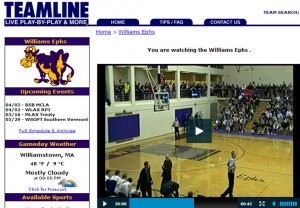
The Williams broadcasters aren't bad but the technology seems straight out of 2003.

The Williams broadcasters aren’t bad but the technology seems straight out of 2003.

Congratulations on having athletic departments and basketball programs specifically that are at the pinnacle of NCAA Division III. Your institutions’ young men and women on the court (and on other playing venues) represent your institutions well. They have performed on the biggest stages in Division III basketball.

Unfortunately, the way most people are viewing your program of late is through your schools’ official athletics webcast, each of which puts your institution in a poor light, for varying reasons.

It’s great that over the years more and more schools have found ways to video stream their games even if it just one camera and no broadcasters. A consistent quality broadcast requires infrastructure, manpower, time and of course, some money, whether you are paying an outside company to host your stream or hosting it on campus.

However, Division III fans, and your institutions deserve better. Amherst and Williams have had plenty of home games this month and have men’s home games on Saturday. You have an opportunity to fix this and raise the bar for this final home game of the season.

It upsets me that not only are these learning experiences that are being thrown away, but also this is the time of year Division III basketball gets to showcase itself and these broadcasts are doing the exact opposite. In order to get the rights to broadcast these games, your institution deals with NCAA partner Turner Sports, which handles rights for all sorts of NCAA Tournament games.

There are requirements and guidelines schools are supposed to follow, including this one:

The Streaming Entity may not denigrate Turner, the NCAA, NCAA member institutions or teams, their players or officials, or any NCAA sport, and must comply in all respects with the NCAA bylaws, rules and regulations in effect, which may be amended from time to time by the NCAA in its sole discretion.

That is pretty important to note. These broadcasts have to have a neutrality to them even if it is a “homer” broadcast team calling the games.

Schools get waivers of the $1,000 per-game rights fees. With that waiver comes those requirements and others, as well as benefits. These broadcasts are linked from NCAA.com as part of the official NCAA bracket, meaning it is being given prominence well beyond your institution and its fanbase. What kind of face does it put on your institution and NCAA Division III in general when your broadcasters act unprofessionally, screaming into the microphones, not bothering to check pronunciations of names, and generally treating the broadcasts as if they were any other fans in the stands rather than spokespersons for your school? That’s how Amherst College portrays itself on its official athletics webcast. If athletics is indeed the front porch of the college, then Amherst’s broadcast makes it look like a frat house.

Now, on the other hand, Williams has a little more professionalism in the commentary. Saturday’s men’s game was quite well done in that aspect. (More on the women’s games in a bit.) But the broadcast itself looks like a first-generation online broadcast, something straight out of 2003. And that was when the video finally came online at halftime. If athletics is the front porch, then Williams’ broadcast makes it look like a dilapidated shack.

The two young ladies calling the Emory/Whitman women’s game at Williams College on Friday night seemed less like broadcasters and more like two people asked to talk about the game with microphones in front of them. I couldn’t figure out who the play-by-play person or color analyst was – they both talked over each other and didn’t particularly describe the game. The crew that called the games that featured Williams was a bit rough, too. The play-by-play lady kept trying to call the game like she was yukking it up with her friends and even tried several times to bait the color guy into slang comments that made no sense and didn’t have a place for a game many people are watching from around the country. That was especially true considering the participating teams were from Georgia and Washington state.

We know technical problems can plague any webcast, whether hosted on campus or by an outside company. What works once doesn’t necessarily work the next time – instead of broadcaster in my description or Broadcast Director in my D3sports title, it probably should read Broadcast Troubleshooter and Director.

Let’s start with Williams: The video feeds looks like it is from the 1990s. The audio broadcast is even harder to deal with since it sounds like the broadcasters are talking through an old telephone line with absolutely no background noise. It sounds like a game being played in the 1980s.

However, to be honest, I would rather listen to those games than the ones at Amherst.

Those guys clearly have no interest in calling the game with any iota of professionalism. They sounded like they happened to have some microphones and thought it would be cool to call the games for their frat brothers while sitting in the stands. Constant complaining about officials’ calls when they aren’t in favor of the Lord Jeffs; snide comments about the opposing team even one comment, “he celebrated like it was an NBA game, I am not sure what that was all about” which had no context especially since the video feed wasn’t working; overall disdain for anything not in purple; lack of preparation, “I think that is how you say his name, but I need to look that up;” and overall a lack of caring. I even heard the “color analyst” acting like a coach yelling out to an Amherst player to watch out for a defender who was coming in for a double-team at mid-court.

I am shocked that a school like Amherst which has name recognition and often hosts games would allow these two to broadcast. Furthermore, I wonder if the NCAA and Turner Sports are watching these broadcasts since they actually own the content.

Let’s get back to two key points: educational experience and the spotlight on these institutions who are streaming games and for Division III as a whole.

How does a reputable school like Amherst allow a broadcast that is so below amateur to represent it? And how can a very reputable liberal arts college think these broadcasters are getting an educational experience? The players on the court are held at a very high standard when it comes how they conduct themselves. Shouldn’t the same high standards be held to the broadcasters on the official webstream for the college?

This applies to all schools in this situation. I have worked with quite a few where they know this experience is something that can better these students so the mission is to make it part of their college education. I know schools with less name notoriety or attention this time of year who would have pulled the plug on the Amherst broadcasters before the first half even ended!

As for the spotlight, we as a Division III family should be embarrassed and ask for something to be done. This is the division we love and cherish and wish would get more attention from national and even local media. These are teams we know will show the basketball world in Atlanta that the Division III brand of basketball is pretty high-caliber. We are proud of these student-athletes and we are proud of those who support these athletes from their coaches to administrators to even broadcasters. But when you turn on showcased games and broadcasters aren’t respecting the magnitude of the game or the viewers, something needs to be done. These broadcasts may be popular among your alumni, especially your young alumni, because they are energetic, but they sound more like a video game than a college basketball contest.

Next weekend the D3hoops.com crew will be Holland, Mich., for the culmination of the women’s basketball season. And perhaps you will be too, since your teams have advanced. I am half-tempted to cancel my trip if I could travel to Amherst or Williams and show them how a broadcast in the Sweet 16 of the NCAA Division III Men’s Basketball Championship tournament should be done. In fact, I would be willing to travel to St. Mary’s (Md.) who doesn’t have a broadcast so that people can compare how bad those other entities are doing it at schools with plenty more national attention because of their institution’s names than most in Division III. Amherst even had a crew of ours in LeFrak Gymnasium earlier in early February for its doubleheader with Tufts University (men’s game tips off at 52-minute mark of that video). That was a crew made up entirely of former student broadcasters, ones who took the role seriously in their time at Division III schools. All of us at D3hoops.com had microphones in front of our faces as students, and we weren’t perfect, but we took the game seriously and worked hard to make ourselves better, even if we weren’t being mentored by anyone.

Plenty of Division III schools have fantastic student broadcasters, and continue to produce quality broadcasts year after year, even though students graduate and move on. If you are in Holland this weekend, stop and listen to what the students from DePauw University sound like. WGRE has been producing quality broadcasts for years, ones that the entire institution can be proud of and put a fine face on Division III. Other schools do so year after year as well, schools such as Ithaca College, North Central College, Wheaton College (Ill.) and others who take it seriously and would never tolerate the type of broadcasts put out recently by Amherst and Williams.

Division III fans shouldn’t stand for this; you and your institutions shouldn’t stand for this; and those broadcasters should realize they are doing far more than embarrassing themselves. They are embarrassing the student-athletes, the athletic departments, their institutions and Division III as a whole.

Advise your students to take themselves seriously, do their homework and respect their opponents. It’s important not only to know how to pronounce the names of starters but also head coaches and assistant coaches, and whether the opponent’s school goes by College or University. You should listen to their tapes, but more importantly, so should they. That is how you get better as a broadcaster. They should learn not to talk over each other, because usually when two people talk, then neither one can be understood.

But most importantly, what they should learn is that a big game tends to bring a big audience, and they need to elevate their game in response. Just as they wouldn’t expect the players on the floor to revert to a playground game when there is a title on the line, they shouldn’t use those two hours as a time to joke around with their buddies.

Dave McHugh
D3sports.com

Centaur Seasons: Revisiting Allentown basketball, 40 years later

Forty years ago we played on a half-good, half-bad basketball team for a brand-new college. Forty years later a lot has changed.

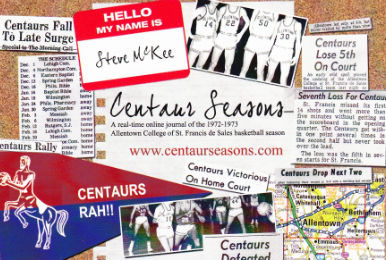
Centaur SeasonsBy Steve McKee

The problem is remembering what to call them. When I played we were the Allentown College of St. Francis de Sales Centaurs. These days they’re the DeSales University Bulldogs.

Centaur-Centdog-Bultaur-Bulldogs. And the mascot and name aren’t the only things that changed a dozen years ago.

When I showed up at the school in Center Valley, Pennsylvania, in the fall of 1970, the college had graduated two classes. There were five buildings, lots of cornfields, maybe 450 students. The barest of bones; a handful of majors. The entire place making itself up as it went along.

“It was the frontier days of the university,” says Jim Naccarato, a guard on the team two years ahead of me and an Oblate of St. Francis de Sales seminarian. “Everyone was taking a gamble. There was real risk. It was an adventure.”

The bet paid off. Today, DeSales University boasts dozens buildings, perhaps 1,700 undergrads, a full complement of majors, all the bells and whistles of a competitive college in the digital world.

As for the basketball teams. Well …

When I arrived the Centaurs’ two-year record was 8-28, with losses of 20, 21, 22 (twice), 26, 27, 37, 41, 42, 61 and … 70. “Nobody was doing anything but trying to win, play the best they could,” says Tom Junod, an under-sized center on those first two teams. “There was a lot of spirit among the people who were there. Everyone wanted the school to succeed. I don’t think any of us felt like we were wasting our time, and I don’t think any of us did. We wanted to win.”

In my four years the Centaur went another 29-44. If you’re scoring at home, for the first six years of the Centaur’s existence, that’s a combined 37-72.

“Wins meant so much to us,” says Dave Glielmi, my roommate junior year. “We used to count them like they were jelly beans when you were a kid.”

Meanwhile, this year’s DeSales Bulldogs are right now 21-6. Saturday they lost to Delaware Valley in the MAC Freedom Conference championship game. On Wednesday they open against Moravian  as the No. 2 seed in the ECAC South Region tournament.  Coach Scott Coval’s teams have won 20 or more games in nine of the last 11 seasons. There have been three appearances in the NCAA D-III postseason. These guys are good.

And here’s the bonus: The better the Bulldogs are now, the better we Centaurs can believe we were then. Don’t think we don’t.

This past September I began posting at “Centaur Seasons.” A “memory blog,” it’s about those early days of Allentown College of St. Francis de Sales and the certain something that I believe came with attending a brand-new school that was right then as much a concept as it was a college. Included in Centaur Seasons are the entries from an actual diary I wrote during the 1972-73 season, my junior year, posted 40 years later in “real” time. But mainly Centaur Seasons is about the striving. The trying to win but too-often losing. The playing in front of a handful of fans. The being there at the beginning. The not knowing what our efforts might bring, but knowing whatever it was we’d be long gone by the time it happened.

“We knew we weren’t going to be the centerfold story in Sports Illustrated,” says Chris Cashman. “We had no real expectations.”

Cash, a year ahead of me, was the classic “last man cut” from his high school team. At Allentown as a 6-3 center-forward he played in every game his first three seasons. Then, senior year, on the first day of practice he ripped up his ankle — and with it the games-played streak.

“We were a Catholic start-up college fielding a start-up team,” he says. “It was what it was. But what was magical about it was that A) we loved to play basketball, B) we grew to kind of love each other, and C) we took ourselves seriously enough not to run out there and knowingly take the chance that we were going to embarrass ourselves – even though, sometimes, we did embarrass ourselves.”

Writing the Centaur Seasons blogs these past few month, I’ve had pleasant occasion to talk to many of my former teammates. It’s been great to reconnect, to hear the old stories. But I’ve also asked them to help me try to get my hands around the certain something that I believe made going to Allentown College when we did a particular, unique experience. If only I can find it.

Tony Mazzeo offered this about the college, immediately. A three-sport letterman, Maz won all the MVPs (soccer, hoops and baseball) and was named the Varsity Athlete of 1971-72 my sophomore year.  “If there had been an Allentown College in the 1930s, would we have cared about it the way we did?” he asked me when we talked. And then he answered: “No.” It’s the fact that there was no Allentown College until we got there, until we made it so, Maz says, that makes our being there so special.  “I am absolutely convinced of this,” he says.

Joe Thomson, meanwhile, suggested this about Centaur Basketball. “In a crazy way, in the purest sense of the word, it was just playing the game for the love of the game,” he says. “There weren’t a lot of externals. We weren’t getting money, we weren’t on scholarship. We didn’t have to worry about who was getting all-conference. We just played. We didn’t like the losing, but when we did we just got ready for the next game. To me it was pure sport. We were just a bunch of guys playing ball.”

Joe was a pass-first junior point guard when I was a senior. I looked to him to get me the ball, which he did, consistently. As a result I, me, Steve McKee, and my 6-foot-8-inches and 165 pounds of pipecleaner body that had not played basketball in high school, became the hoops star I had long wanted to be. Even if just for one year. Even if just at brand-new Allentown College of St. So-On and So-Forth.

Joe told me about a visit to Center Valley a couple of years ago. “I went back and saw how beautiful the campus is,” he said. “There’s a soccer field right in the middle of the place now! I got choked up. We had not even a quarter of all this. I looked around – the beautiful facilities, the townhouses up on the hill, everyghing going on — and thought, Man, this is a real college now. But you know, what? We had a real college too.”

Which is why I think this is telling: Not one of my teammates I’ve talked to has said they wished they were going to DeSales U now, playing for the Bulldogs at a packed Billera Hall, taking a run at conference titles, postseason play, league honors, all that.  No, thanks, we’re fine.

“If we go back to a game now,” says Dave Gleilmi, a 6-2 forward and arguably the best player of the Centaur Season era, “the place is called DeSales University and we’re watching a team called the Bulldogs – that is obviously A LOT better than we used to be. But then we get together after and we have a few drinks and now we’re the Centaurs again, we’re Allentown College. And nobody’s saying, ‘Geez, I wish we were DeSales University.’ That wouldn’t be right. We were who we should have been, and we always will be.”

The Centaur-Centdog-Bultaur-Bulldogs? They are who they should always be. As Jerry Wilkinson —  with Tony Mazzeo the co-captain of a half-good 8-8 Centaur team their senior year — wrote me in an email after some of us got together for a Bulldog game: “I do hope these kids today feel anywhere near the joy that we do that we played way back when.”

Joy. Yes, that’s the right word. Feel it forever, Bulldogs, forever.

This essay is drawn from the CENTAUR SEASONS posts Steve McKee has written since September. Most of the links here are to specific CENTAUR SEASONS  entries.  Steve worked for 14 years at The Wall Street Journal, where he was the first writer of the popular online sports blog, “The Daily Fix.” He is the author of three books, including “COACH,” an oral history of the sideline profession.

Who’s in the men’s tournament?

Here are the 42 conferences with automatic bids to the 2013 NCAA Division III men’s basketball tournament and winners, when clinched. Each team’s seed in the conference tournament is noted in parentheses. Congratulations to Concordia-Texas, Fitchburg State, St. Vincent and Spalding on earning their first ever trip to the NCAA Division III men’s basketball tournament.

For teams not in one of these 42 conferences, there is one bid set aside (Pool B). There are 19 at-large bids (Pool C) that make up the rest of the field.

Allegheny Mountain Collegiate Conference: Penn State-Behrend (3)
American Southwest Conference: Concordia, Tex. (West-2)
Capital Athletic Conference: St. Mary’s, Md. (1)
Centennial Conference: Dickinson (2)
City University of New York Athletic Conference: Staten Island (1)
College Conference of Illinois and Wisconsin: North Central, Ill. (2)
Colonial States Athletic Conference: Cabrini (1)
Commonwealth Coast Conference: Curry (1)
Empire 8: Ithaca (2)
Great Northeast Athletic Conference: Albertus Magnus (2)
Heartland Collegiate Athletic Conference: Rose-Hulman (1)
Iowa Intercollegiate Athletic Conference: Dubuque (3)
Landmark Conference: Catholic (1)
Liberty League: Hobart (1)
Little East Conference: Rhode Island College (1)
Massachusetts State College Athletic Conference: Fitchburg State (5)
Michigan Intercollegiate Athletic Association: Calvin (1)
Middle Atlantic Commonwealth: Alvernia (1)
Middle Atlantic Freedom: Delaware Valley (2)
Midwest Conference: St. Norbert (1)
Minnesota Intercollegiate Athletic Conference: St. Thomas (1)
New England Collegiate Conference: Elms (1)
New England Small College Athletic Conference: Amherst (1)
New England Women’s and Men’s Athletic Conference: WPI (1)
New Jersey Athletic Conference: Ramapo (1)
North Atlantic Conference: Husson (2)
North Coast Athletic Conference: Ohio Wesleyan (2)
North Eastern Athletic Conference: Morrisville State (1)
Northern Athletics Conference: Aurora (2)
Northwest Conference: Whitworth (1)
Ohio Athletic Conference: Marietta (2)
Old Dominion Athletic Conference: Randolph-Macon (3)
Presidents Athletic Conference: St. Vincent (1)
St. Louis Intercollegiate Athletic Conference: Spalding (1)
Skyline Conference: SUNY-Purchase (2)
Southern California Intercollegiate Athletic Conference: Redlands (1)
Southern Collegiate Athletic Conference: Trinity, Tex. (1)
State University of New York Athletic Conference: Cortland State (1)
University Athletic Association: Washington U. (no tournament)
Upper Midwest Athletic Conference: Northwestern, Minn. (1)
USA South Athletic Conference: Christopher Newport (1)
Wisconsin Intercollegiate Athletic Conference: UW-Whitewater (2)

Who’s in the women’s tournament?

Here are the 43 teams with automatic bids to the 2013 NCAA Division III women’s basketball tournament. Each team’s seed in the conference tournament is noted in parentheses. Congratulations to Cornell, FDU-Florham, Huntingdon, Lancaster Bible, New Paltz State, St. Scholastica and Texas-Dallas on earning their first ever trip to the NCAA Division III women’s basketball tournament.

Allegheny Mountain Collegiate Conference: La Roche (1)
American Southwest Conference: Texas-Dallas (East-2)
Capital Athletic Conference: Marymount (1)
Centennial Conference: Gettysburg (1)
City University of New York Athletic Conference: Baruch (1)
College Conference of Illinois and Wisconsin: Carthage (1)
Colonial States Athletic Conference: Cabrini (1)
Commonwealth Coast Conference: University of New England (1)
Empire 8: Ithaca (1)
Great Northeast Athletic Conference: Emmanuel (1)
Great South Athletic Conference: Huntingdon (1)
Heartland Collegiate Athletic Conference: Hanover (3)
Iowa Intercollegiate Athletic Conference: Simpson (1)
Landmark Conference: Catholic (1)
Liberty League: St. Lawrence (2)
Little East Conference: Southern Maine (1)
Massachusetts State College Athletic Conference: Bridgewater State (1)
Michigan Intercollegiate Athletic Association: Hope (1)
Middle Atlantic Commonwealth: Lebanon Valley (3)
Middle Atlantic Freedom: FDU-Florham (1)
Midwest Conference: Cornell (1)
Minnesota Intercollegiate Athletic Conference: St. Thomas (2)
New England Collegiate Conference: Regis (Mass.) (1)
New England Small College Athletic Conference: Amherst (2)
New England Women’s and Men’s Athletic Conference: Babson (1)
New Jersey Athletic Conference: Montclair State (1)
North Atlantic Conference: Colby-Sawyer (2)
North Coast Athletic Conference: DePauw (1)
North Eastern Athletic Conference: Lancaster Bible (1)
Northern Athletics Conference: Wisconsin Lutheran (1)
Northwest Conference: Whitworth (2)
Ohio Athletic Conference: Ohio Northern (1)
Old Dominion Athletic Conference: Guilford (2)
Presidents Athletic Conference: Thomas More (1)
St. Louis Intercollegiate Athletic Conference: Westminster, Mo. (1)
Skyline Conference: Farmingdale State (4)
Southern California Intercollegiate Athletic Conference: Cal Lutheran (1)
Southern Collegiate Athletic Conference: Trinity, Tex. (1)
State University of New York Athletic Conference: New Paltz State (1)
University Athletic Association: Emory (no tournament)
Upper Midwest Athletic Conference: St. Scholastica (4)
USA South Athletic Conference: Christopher Newport (2)
Wisconsin Intercollegiate Athletic Conference: UW-Stevens Point (3)

NCAA regional rankings, week 3

Virginia Wesleyan athletics photo

Virginia Wesleyan moves into the top spot in the ODAC tournament seedings and the South Region rankings this week.

The men’s and women’s regional rankings have both been released.

Need to know more about the regional rankings process and what they mean? Need to know more about the NCAA Tournament? Check out our NCAA Tournament FAQ.

Through games of Sunday, Feb. 17.

The first record is in-region record, followed by overall.

  • NCAA Division III men’s basketball championships handbook
    Men’s rankings
    Atlantic Region
    NCAA data sheet
    1 Ramapo 19-3 21-4
    2 SUNY-Old Westbury 21-2 22-3
    3 Rutgers-Newark 18-6 19-6
    4 Richard Stockton 19-6 19-6
    5 SUNY-Purchase 20-5 20-5

    EastNCAA data sheet
    1 Rochester 20-3 21-3
    2 Cortland State 21-3 21-4
    3 Stevens 20-4 22-4
    4 Plattsburgh State 18-6 18-7
    5 Hobart 18-6 19-6
    6 Oswego State 18-7 18-7

    Great LakesNCAA data sheet
    1 Wooster 20-4 20-4
    2 Ohio Wesleyan 19-4 19-5
    3 St. Vincent 18-3 20-5
    4 Thomas More 20-3 21-4
    5 Capital 19-4 19-6
    6 Calvin 18-1 22-3

    Mid-AtlanticNCAA data sheet
    1 Alvernia 21-4 21-4
    2 Catholic 19-3 22-3
    3 Albright 20-5 20-5
    4 St. Mary’s (Md.) 17-3 22-3
    5 Wesley 16-3 19-6
    6 Scranton 19-6 19-6
    7 DeSales 19-5 20-5
    8 Salisbury 15-5 18-7
    9 Franklin & Marshall 16-5 19-6

    MidwestNCAA data sheet
    1 Illinois Wesleyan 18-3 21-3
    2 Washington U. 18-5 19-5
    3 Wheaton (Ill.) 16-5 19-5
    4 North Central (Ill.) 19-3 21-3
    5 Transylvania 18-5 19-6
    6 Rose-Hulman 21-3 22-3
    7 St. Norbert 18-5 18-5
    8 Augustana 16-7 17-7

    NortheastNCAA data sheet
    1 Amherst 23-2 23-2
    2 WPI 23-2 23-2
    3 Williams 20-3 22-3
    4 Rhode Island College 22-3 22-3
    5 Middlebury 19-2 22-2
    6 MIT 19-4 20-4
    7 Springfield 18-7 18-7
    8 Brandeis 17-7 17-7
    9 Curry 18-7 18-7
    10 Westfield State 19-4 21-4
    11 Eastern Connecticut 18-4 18-7
    12 Tufts 16-5 17-8

    SouthNCAA data sheet
    1 Virginia Wesleyan 16-5 19-6
    2 Hampden-Sydney 18-3 22-3
    3 Mary Hardin-Baylor 21-4 21-4
    4 Christopher Newport 17-5 18-5
    5 Emory 17-6 17-6
    6 Concordia (Texas) 18-4 20-5
    7 Texas-Dallas 19-6 19-6
    8 Randolph 14-5 20-5

    WestNCAA data sheet
    1 St. Thomas 24-1 24-1
    2 UW-Stevens Point 21-4 21-4
    3 UW-Whitewater 20-4 21-4
    4 Whitworth 21-3 22-3
    5 Buena Vista 18-6 19-6
    6 UW-Stout 18-6 19-6
    7 Concordia-Moorhead 18-6 18-7
    8 Augsburg 19-6 19-6
    9 Whitman 15-6 18-7

    Regional score reporting forms (including SOS) below:
    Atlantic | East | Great Lakes | Middle Atlantic | Midwest | Northeast | South | West

    Women’s
    AtlanticNCAA data sheet
    1 Montclair State 25-0 25-0
    2 Catholic 21-1 24-1
    3 Baruch 23-2 24-2
    4 Marymount 19-4 21-4
    5 William Paterson 18-6 19-6
    6 Mary Washington 17-6 19-6
    7 York (Pa.) 15-6 19-6
    8 TCNJ 17-8 18-8

    CentralNCAA data sheet
    1 Cornell 22-1 22-1
    2 UW-Whitewater 18-4 20-5
    3 Washington U. 18-4 19-5
    4 Carthage 18-4 20-4
    5 UW-Oshkosh 17-5 20-5
    6 Illinois Wesleyan 15-5 17-7
    7 Monmouth 18-4 19-4
    8 UW-Stevens Point 19-5 20-5

    EastNCAA data sheet
    1 Ithaca 21-2 23-2
    2 Rochester 19-5 19-5
    3 New Paltz State 22-3 22-3
    4 Geneseo State 18-6 19-6
    5 Vassar 19-4 21-4
    6 Oswego State 17-7 17-8
    7 St. Lawrence 16-8 17-8
    8 Hartwick 15-6 18-7

    Great LakesNCAA data sheet
    1 Ohio Northern 23-0 24-1
    2 DePauw 19-0 25-0
    3 Hope 21-1 24-1
    4 Calvin 18-1 22-2
    5 Thomas More 24-1 24-1
    6 La Roche 21-2 22-2
    7 Otterbein 19-5 20-5
    8 Franklin 19-4 21-4

    Mid-AtlanticNCAA data sheet
    1 Messiah 20-2 22-3
    2 Widener 20-4 21-4
    3 Moravian 19-5 20-5
    4 Scranton 17-6 18-7
    5 FDU-Florham 21-3 22-3
    6 Swarthmore 18-5 19-6
    7 Lebanon Valley 21-4 21-4
    8 (King’s) 19-5 20-5
    Although the NCAA posting left this last spot blank, we believe this is King’s.

    NortheastNCAA data sheet
    1 Amherst 23-1 24-1
    2 Tufts 22-2 23-2
    3 Babson 22-1 23-2
    4 Southern Maine 22-1 24-1
    5 Bridgewater State 21-3 21-3
    6 Williams 20-4 21-4
    7 Smith 22-3 22-3
    8 Castleton State 23-1 24-1
    9 University of New England 21-4 21-4
    10 Emmanuel 20-3 20-5

    SouthNCAA data sheet
    1 Ferrum 22-3 22-3
    2 Christopher Newport 22-2 23-2
    3 Louisiana College 20-3 21-3
    4 Maryville (Tenn.) 22-3 22-3
    5 Eastern Mennonite 17-3 19-5
    6 Howard Payne 21-4 21-4
    7 Trinity (Texas) 21-4 21-4
    8 Emory 21-3 21-3

    WestNCAA data sheet
    1 Simpson 19-1 23-2
    2 Lewis and Clark 19-2 23-2
    3 St. Thomas 20-4 20-5
    4 Concordia-Moorhead 20-4 20-5
    5 Cal Lutheran 18-4 21-4
    6 Whitman 16-3 20-4
    7 Chapman 17-4 19-5
    8 Minnesota-Morris 17-0 18-7

    The first record is in-region record, followed by overall record.

  • NCAA Division III women’s basketball championships handbook

    Regional score reporting forms (including SOS) below:
    Atlantic | Central | East | Great Lakes | Mid-Atlantic | Northeast | South | West